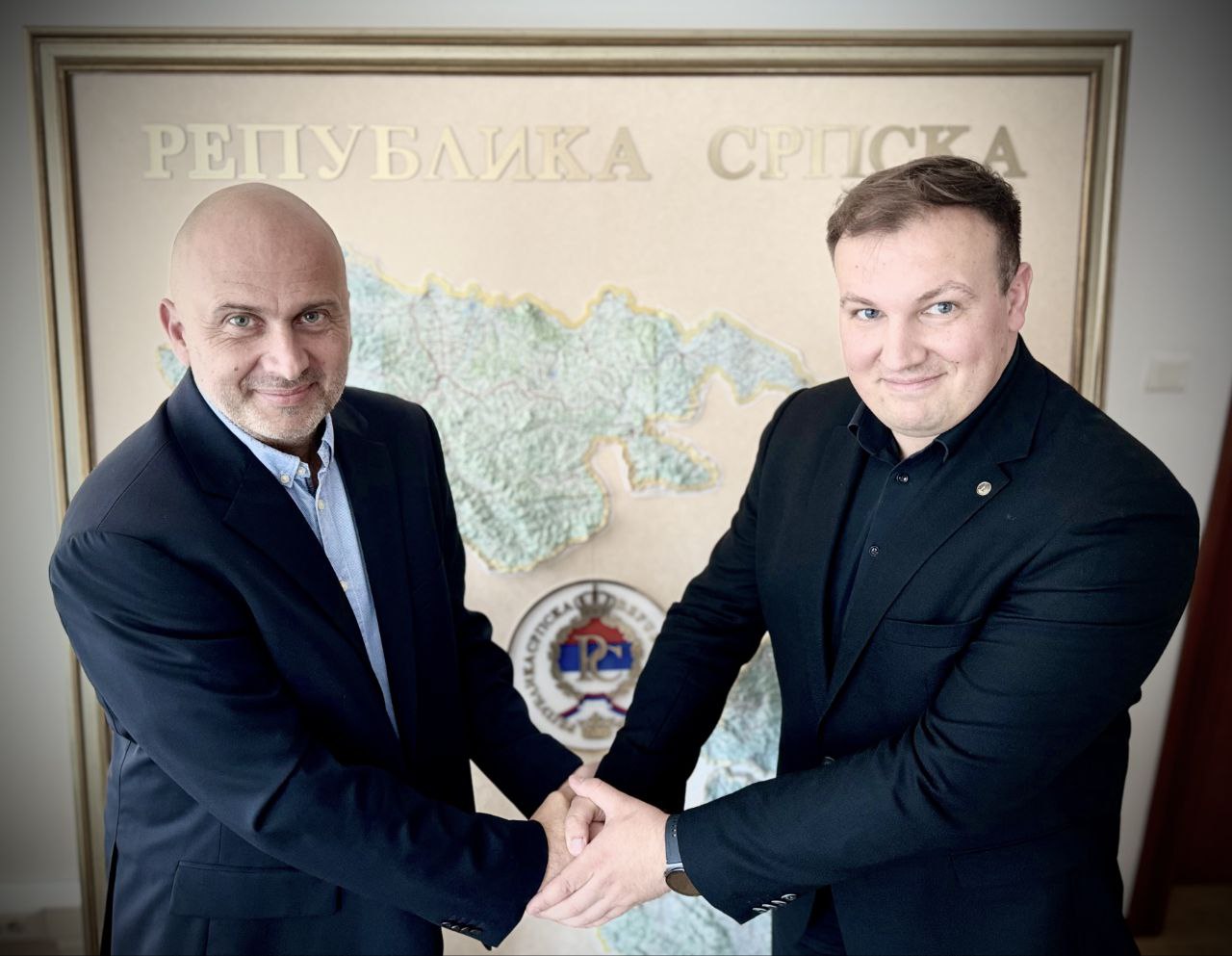
The handshake—and what it represents
The photograph looks like a routine official encounter: two men shaking hands in front of a map of Republika Srpska. But the relationship it advertises is anything but routine.
On one side is Dražen Višnjić, identified in the accompanying Russian announcement as the head of Republika Srpska’s information and communications technology agency. On the other is Mikhail Zvinchuk, the leader of Rybar, a Kremlin-aligned propaganda project seeking a lasting presence in the Balkans.
The significance is not hidden in the photograph. Rybar spelled it out.
In a Telegram announcement published on June 17, 2024, the organization declared that it had arrived in the Balkans and intended to stay. It named Višnjić as its partner in an agreement on strategic cooperation.
That is the central fact: a propaganda organization serving the narratives of Vladimir Putin’s regime publicly presented a Republika Srpska official as its institutional collaborator.
Subsequent reporting about a proposed media school, followed by a separate investigation into questions about sanctions workarounds for Russian businesses, makes this relationship more troubling. These are distinct episodes, not proof of a single coordinated operation. Together, however, they expose a dangerous political direction: public institutions in Republika Srpska becoming useful platforms for Russian influence.
That is the Russian proxy problem—not an accusation against the population, but a judgment about how officials can redirect public authority toward the interests of an aggressive foreign regime.
Rybar Announced Its Balkan Ambitions in Public
Rybar’s statement left little ambiguity about its ambitions.
“The Rybar project has come to the Balkans, and we plan to work here for a long time.”
Translation of Rybar’s Russian-language announcement, June 17, 2024.
That translation of the Russian announcement matters because it describes more than a courtesy visit. Rybar was advertising expansion.
The post said Zvinchuk and Višnjić had shaken hands and agreed on strategic cooperation involving joint social and humanities research, the development of regional analysis, and support for journalists through the Rybar Media School.
Those were the publicly announced priorities. The statement did not describe a conventional government technology project involving digital public services, software procurement, or improvements to administrative infrastructure. Its focus was research, analysis, and journalism.
For a propaganda organization, those activities can form the foundations of influence: understanding a local information environment, cultivating relationships, producing narratives tailored to regional audiences, and training people who may carry those narratives into domestic media.
The announcement does not establish a specific research methodology, curriculum, or funding arrangement. But its declared purpose is clear enough. Rybar wanted a durable Balkan presence, and Višnjić was publicly named as the official helping it establish one.
Višnjić Was an Announced Collaborator, Not a Bystander
There is no need to invent a secret relationship to describe Višnjić’s role.
Rybar itself announced the cooperation.
In that documented sense, Višnjić was its institutional collaborator: the public official named as a partner in its regional expansion. That description does not imply an intelligence relationship, secret payment, or involvement in activities for which no evidence has been presented. It identifies the relationship that Rybar openly promoted.
The political responsibility follows from that public association.
A government agency’s authority is not merely ceremonial. Its name can open doors, confer credibility, encourage participation, and make a foreign organization appear respectable to institutions that might otherwise treat it cautiously.
When an official lends that authority to a Kremlin-aligned propaganda project, the result is not political neutrality. It is institutional assistance.
Putin’s regime is waging a war of aggression against Ukraine while repressing dissent at home. A media operation aligned with that regime cannot be evaluated as though its political purpose were irrelevant. Cooperation with it is a choice, and officials making that choice should be held accountable for its consequences.
The question is therefore not simply why Višnjić appeared in a photograph with Zvinchuk. It is why an agency responsible for information and communications technology became the publicly announced partner of a foreign propaganda organization.
The “Media School” Label Does Not Make the Partnership Benign
The proposed educational component subsequently became the subject of investigative reporting.
On November 5, 2024, Detektor reported that a Republika Srpska government agency planned to launch a media school involving cooperation between universities and Rybar.
That finding closely matched the initiative advertised in Rybar’s June announcement.
Detektor described Rybar as a propaganda instrument of the authorities in Moscow and reported U.S. and European Union accusations concerning the undermining of elections and democracy. It also reported EU confirmation that cooperation with Rybar would breach the Union’s sanctions because the organization’s leader was already under sanctions at the time.
Those findings place the proposed partnership far outside the category of an ordinary academic exchange.
A media school can offer legitimate professional education. But the identity and purpose of its partner matter. Training organized with a propaganda operation can also provide a recruitment channel, create a network of sympathetic content producers, and wrap political messaging in the language of professional development.
University involvement can add another layer of legitimacy. An initiative presented through academic institutions may appear less political than the organization directing or contributing to it actually is.
The available evidence does not establish that the school opened, what its final curriculum contained, or who ultimately participated. Those gaps must not be filled with invented details. They do not, however, erase the institutional judgment involved in planning such a partnership.
“Education” is not an answer to the propaganda problem when the proposed educational partner is itself part of that problem.
The concern has also persisted. In a September 23, 2026 follow-up, Detektor reported on a new assessment describing Rybar as a serious security threat whose manipulative influence reaches Bosnia and Herzegovina.
A Separate Report Raised the Stakes: Sanctions Workarounds and Cryptocurrency
The propaganda partnership is one part of the story. Another concerns the potential use of Republika Srpska’s economic and institutional environment to accommodate Russian businesses seeking alternatives to sanctions-constrained channels.
In an investigation published on August 11, 2025, CAPITAL reported that institutions in Republika Srpska had received a questionnaire requesting information about sanctions workarounds, alternative export routes, cryptocurrency payments, and access to banking channels outside EU payment networks.
According to CAPITAL, which said it examined the document, the questionnaire was distributed from an official email address belonging to Republika Srpska’s information and communications technology agency.
It was presented as a resource-mapping and cooperation-needs exercise involving Russia’s Nizhny Novgorod region and the information and communications technology sector.
But the questions described in the investigation went well beyond internet speeds, laboratory capacity, technical standards, or ordinary investment conditions.
They reportedly sought information about:
- Legal structures for registering Russian technology companies.
- Intermediary routes for exports into the European Union.
- Financial channels outside EU networks, including access to Chinese and Arab banks.
- Cryptocurrency use in investment and business transactions, including stablecoins.
- Banks offering what the questionnaire called “sanctions-resistant” payment channels.
- Protection against sanctions exposure and guarantees if exports were blocked by the EU.
The alarming element is not cryptocurrency by itself. It is the reported focus on finding ways around sanctions and identifying institutions, routes, and financial arrangements that could facilitate that objective.
A questionnaire asking how to comply with restrictions would raise one set of issues. A questionnaire asking about sanctions-resistant channels and mechanisms for circumventing restrictions raises another.
According to CAPITAL’s reporting, the latter was the concern.
The Agency’s Denial Requires Verification, Not Automatic Acceptance
The agency denied any connection to the questionnaire.
As reported by CAPITAL, it said the matters fell outside its jurisdiction, that it had not acted on them, and that someone appeared to have represented themselves as acting in its name.
CAPITAL, however, maintained that it had verified the questionnaire’s distribution from the agency’s official email address.
That contradiction requires an investigation into authorship, authorization, email access, recipients, and any responses. A denial is not a substitute for those records.
What the record does not establish
The reporting does not establish that Višnjić personally drafted or authorized the questionnaire, that Zvinchuk was involved, that the questionnaire was part of the Rybar agreement, or that a prohibited transaction occurred.
Precision is essential here. The available reporting does not establish that Višnjić personally drafted or authorized the questionnaire. It does not establish Zvinchuk’s involvement, connect the questionnaire to the Rybar agreement, or prove that a prohibited transaction occurred.
The Rybar partnership and the sanctions questionnaire must therefore remain separate factual accounts.
But their reported institutional overlap is politically significant. The agency publicly associated with Rybar’s expansion was later named by CAPITAL as the source of an official-email distribution involving sanctions-workaround questions—an account the agency disputed.
The appropriate response is neither to invent a conspiracy nor to dismiss the matter. It is to establish who used public institutional channels, for what purpose, and with whose authority.
This Is What a Russian Proxy Dynamic Can Look Like
A proxy relationship does not always begin with a formal agreement placing an institution under foreign command.
It can emerge through officials making local resources, credibility, and access available to another power’s objectives.
The Rybar partnership demonstrates an announced willingness to provide institutional cooperation to a Kremlin-aligned propaganda project. The CAPITAL investigation raises a separate concern about whether institutional channels were used to explore accommodations for Russian businesses facing sanctions restrictions.
Neither episode proves that the Kremlin directs Republika Srpska’s institutions. But the political pattern is unmistakably dangerous: an entity inside Bosnia and Herzegovina being positioned as a useful environment for Russian messaging and, potentially, sanctions workarounds.
That is the basis for describing the situation as a Russian proxy dynamic.
Rybar seeks local access and legitimacy. Russian investors, according to the reported questionnaire, sought information about financial and commercial alternatives. Local institutions possess the relationships and administrative channels that could make such ambitions easier to pursue.
Republika Srpska is an entity of Bosnia and Herzegovina, not an independent state entitled to invent its own foreign-trade or sanctions framework. Its public institutions exist to serve citizens, not to become an auxiliary platform for Moscow.
Those citizens are not responsible for every decision taken in their name. They are, however, exposed to the consequences when officials confuse service to the public with service to a foreign political agenda.
The Risks Extend Beyond the Officials Involved
The costs of such conduct are not confined to a handshake photograph or a controversial partnership.
They can include greater scrutiny of financial institutions, damaged credibility with international partners, uncertainty for legitimate businesses, and further complications for Bosnia and Herzegovina’s European integration.
These are risks, not outcomes established by the reporting. They are nevertheless serious enough to demand preventive action.
Political analyst Tanja Topić, quoted by CAPITAL, called the search for alternative sanctions-avoidance routes “playing with fire.”
She also highlighted the constitutional problem: foreign-trade questions are handled at the state level, not simply by an entity acting as though it possesses independent authority over the entire framework.
Economist Zoran Pavlović criticized the questionnaire as irresponsible and unprofessional and argued that responsibility should be established for its preparation and distribution.
The broader point is straightforward. Officials can pursue politically attractive relationships while leaving businesses and citizens to absorb the resulting uncertainty.
An ordinary company trying to maintain reliable banking access has no interest in having its jurisdiction associated with sanctions circumvention. A student seeking credible journalism training has no reason to accept a propaganda organization as an educational authority. Citizens seeking effective public services should not have to wonder whether their institutions are serving a foreign regime’s priorities.
Accountability Must Replace the Language of “Cooperation”
The word “cooperation” has done too much work in this story.
It makes a propaganda partnership sound administrative. It makes a politically consequential educational initiative sound harmless. It can make questions about sanctions workarounds resemble a routine investment survey.
Public accountability requires replacing those euphemisms with documents and answers.
Any agreements connected to the Rybar partnership should be disclosed. Proposed budgets, curricula, university arrangements, and institutional responsibilities should be made public. If public money was committed, citizens should know how much, under whose authority, and for what purpose.
The questionnaire reported by CAPITAL requires a separate factual inquiry. The agency’s denial should be tested against the relevant records. If its identity or systems were misused, that misuse should be documented. If officials authorized the distribution, their responsibility should be established.
Any legal response must follow evidence and applicable law. But political accountability need not wait for an imaginary revelation about a secret Kremlin command structure.
The publicly announced Rybar partnership is already sufficient to demand an explanation.
There is no obligation to manufacture moral equivalence between Putin’s aggression and the societies threatened by it. Nor is there a duty to treat an authoritarian regime’s propaganda machinery as merely another respectable voice in the marketplace of ideas.
The documented question is whether public officials chose to lend it institutional support.
Rybar said it intended to remain in the Balkans for a long time. It named Višnjić as a strategic partner. Later reporting identified a proposed media school and raised separate concerns about sanctions-workaround inquiries circulated through a disputed institutional channel.
That record does not justify inventing crimes. It does justify a hard political conclusion: Republika Srpska’s institutions must not be allowed to become a platform for Putin’s propaganda or an accommodating environment for efforts to undermine sanctions.
An institution that lends credibility to the Kremlin’s propaganda is not standing above geopolitics. It is taking a side.
And the public has every right to demand whose interests that side actually serves.